
Post Office TD Calculator: Estimate Your Time Deposit Returns (2026)
A Post Office TD calculator helps you estimate the interest and maturity value of a Post Office Time Deposit before you invest. You enter the amount and tenure, and it shows your returns instantly.
This guide explains how the calculator works, the latest interest rates, the extension rules, and how a Post Office TD compares with a bank fixed deposit.
What Is a Post Office TD Calculator?
The Post Office Time Deposit (TD), also called the Post Office FD or National Savings Time Deposit, is a government-backed fixed deposit offered by India Post.
A Post Office TD calculator is a simple online tool that applies the official interest formula for you. It removes the manual math and shows your annual payout and maturity value in seconds.
You can try our Post Office TD Calculator to model any amount across the 1, 2, 3 and 5-year terms.
Post Office TD Interest Rates (2026)
Post Office TD rates rise with tenure. For 2026 they range from 6.90% to 7.50% per year, and are the same for all depositors, including senior citizens.
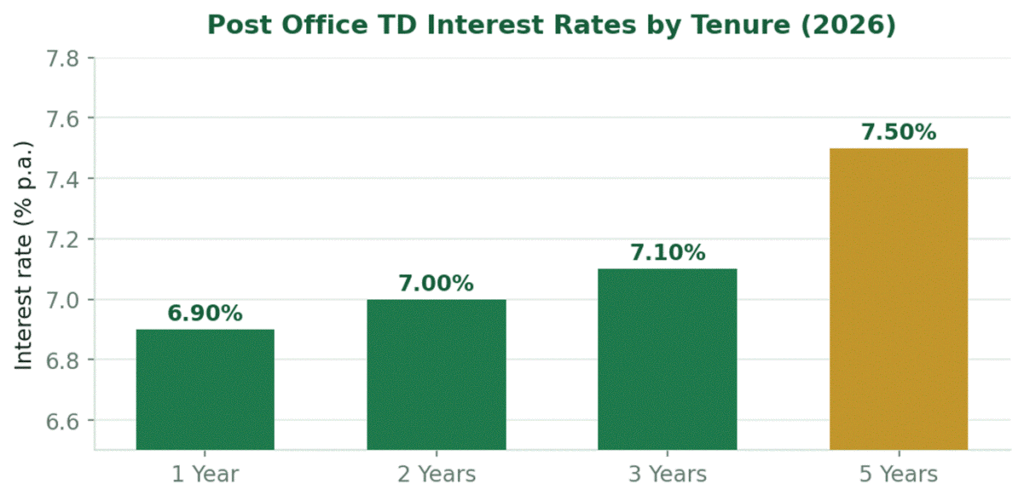
| Tenure | Rate (p.a.) | Effective yield | Annual interest (₹1,00,000) | Maturity (₹1,00,000) |
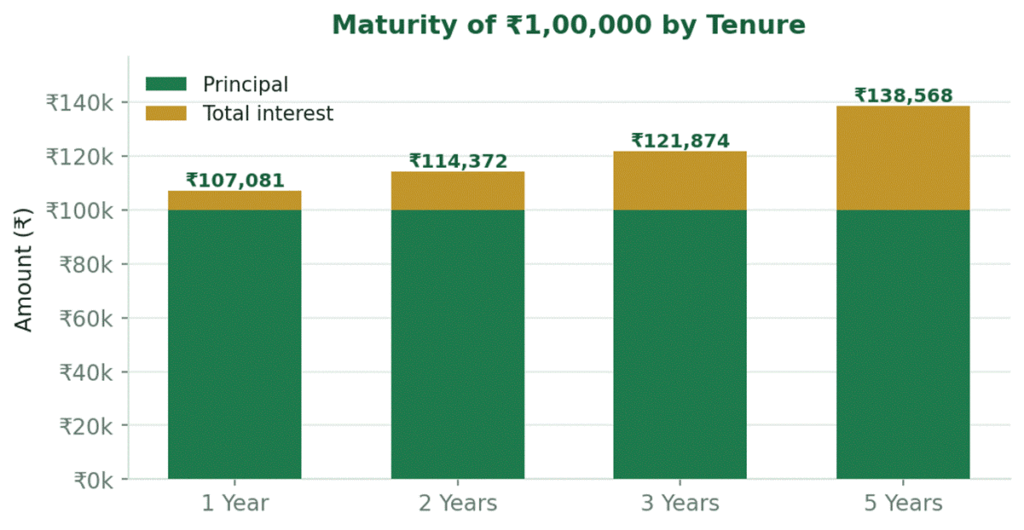
| 1 Year | 6.90% | 7.08% | ₹7,081 | ₹1,07,081 |
| 2 Years | 7.00% | 7.19% | ₹7,186 | ₹1,14,372 |
| 3 Years | 7.10% | 7.29% | ₹7,291 | ₹1,21,874 |
| 5 Years | 7.50% | 7.71% | ₹7,714 | ₹1,38,568 |
Rates are reviewed every quarter by the Ministry of Finance, and your rate stays fixed once the TD is opened. See the official scheme details on the India Post savings page.
How Is Post Office TD Interest Calculated?
Post Office TD interest is compounded quarterly but paid out annually. The formula for one year is: Annual interest = P × [(1 + r/4)^4 − 1], where P is your deposit and r is the annual rate.
Quarterly compounding makes the effective yield slightly higher than the headline rate. For example, a 7.50% rate works out to about 7.71% effective.
Importantly, once the yearly interest becomes due it is not reinvested, so it does not earn further interest. Each year therefore earns the same amount.
Annual Payout vs Maturity Value
The calculator shows two figures. The annual payout is the interest credited to you each year; the maturity value is your principal plus the total interest over the full term.
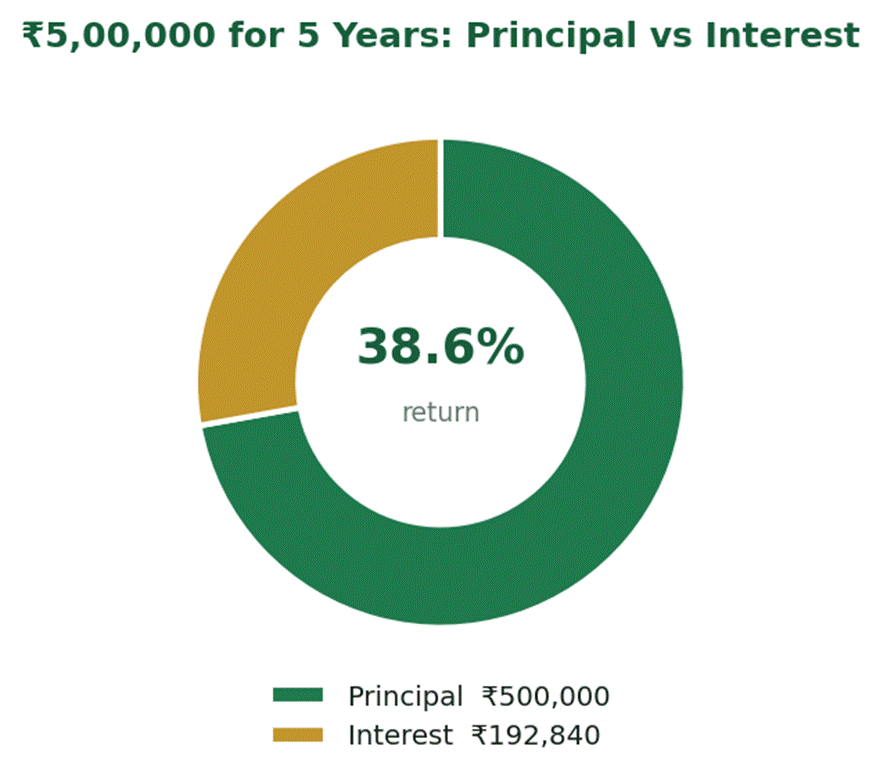
Example: ₹5,00,000 in a 5-year TD at 7.50% earns about ₹38,568 every year. Over five years that is ₹1,92,840 in interest, for a maturity value of ₹6,92,840.
Longer tenures grow your total interest, as the stacked view below shows for a ₹1,00,000 deposit.
Post Office TD Extension Rules and Scenarios
On maturity you can extend a TD for another term equal to the original one. The interest rate applicable on the maturity date applies to the extended term.
| Tenure | Extension window from maturity |
| 1 Year TD | Within 6 months |
| 2 Year TD | Within 12 months |
| 3 Year TD | Within 18 months |
| 5 Year TD | Within 18 months |
You can request the extension when opening the account, and you may extend a maximum of two times after the first maturity.
Scenario 1 — Extending a 5-Year TD on Time
Suppose a 5-year TD matures on 1 April 2031. You have until 1 October 2032 (18 months) to extend it for another five years at the rate in force on the maturity date.
Scenario 2 — Missing the Extension Window
If you do not extend within the allowed window, the deposit is treated as closed on maturity. You receive the maturity amount, and a later extension is not permitted under the scheme.
Post Office TD vs Bank Fixed Deposit
Both are safe options, but they differ on backing, tax, and senior-citizen rates. The table below highlights the key points.
| Feature | Post Office TD | Bank Fixed Deposit |
| Backing | Government of India (sovereign) | DICGC insured up to ₹5 lakh |
| TDS on interest | No TDS deducted | 10% if interest over ₹40,000 (₹50,000 seniors) |
| Senior-citizen rate | Same as general public | Usually +0.25% to +0.50% |
| Section 80C | 5-year TD eligible | 5-year tax-saver FD eligible |
| Rate revision | Quarterly, by the Government | Set by each bank |
For a wider view of bank options, use our FD rates comparison tool alongside this calculator.
Tax Benefits on Post Office TD (Section 80C)
Only the 5-year Post Office TD qualifies for a deduction of up to ₹1.5 lakh under Section 80C, and only under the old tax regime.
The 1, 2 and 3-year terms do not offer this benefit. Interest earned is taxable as per your income slab, though India Post does not deduct TDS at source.
How to Use the Post Office TD Calculator
- Enter your deposit amount (minimum ₹1,000, no maximum).
- Select the tenure: 1, 2, 3 or 5 years.
- Click Calculate to see the rate, annual payout, total interest and maturity value.
- Review the extension window shown for your chosen term.
You can also plan a laddered strategy with our FD laddering calculator to balance liquidity and returns.
Frequently Asked Questions (FAQs)
What is a Post Office TD calculator?
It is an online tool that estimates the annual interest and maturity value of a Post Office Time Deposit based on your deposit amount and chosen tenure.
What is the current Post Office TD interest rate in 2026?
Rates are 6.90% (1 year), 7.00% (2 years), 7.10% (3 years) and 7.50% (5 years) per year, compounded quarterly and paid annually.
Is Post Office TD interest paid monthly or annually?
Interest is calculated quarterly but paid once a year. The Time Deposit has no monthly payout option.
Does Post Office TD qualify for Section 80C?
Only the 5-year TD qualifies for a Section 80C deduction of up to ₹1.5 lakh, and only under the old tax regime.
Can I extend my Post Office TD after maturity?
Yes. You can extend within 6 months (1-year TD), 12 months (2-year TD) or 18 months (3 and 5-year TD) of maturity, up to two times.
Is there TDS on Post Office TD interest?
No. India Post does not deduct TDS, but the interest is taxable under your income slab and must be declared.
What is the minimum and maximum deposit?
The minimum is ₹1,000 in multiples of ₹100. There is no maximum limit.
Do senior citizens get a higher Post Office TD rate?
No. Unlike many banks, the Post Office offers the same TD rate to senior citizens and the general public.
Final Thoughts
A Post Office TD calculator turns the scheme’s quarterly-compounding math into clear numbers, so you can pick the right term with confidence.
Use it to compare tenures, plan extensions and check your Section 80C benefit before you invest. Always confirm the latest rates on the official India Post site.